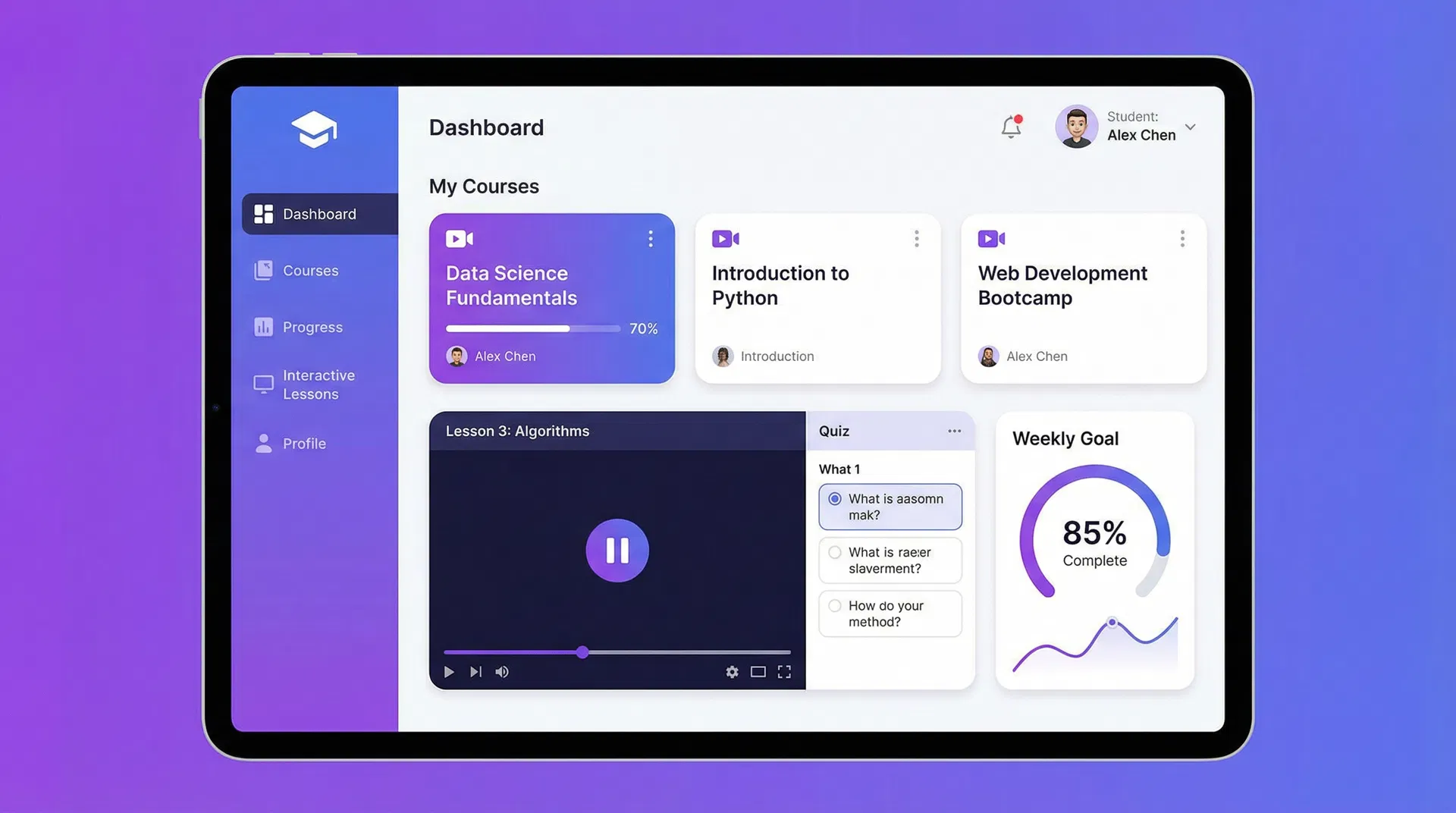
EdTech Platform User Onboarding
Reducing Time-to-First-Value for Online Learning
Company
LearnHub Technologies
Location
Edinburgh, UK
Duration
2022 - 2023
Role
Senior UX Researcher
Overview
Optimized onboarding experience for an educational technology platform through iterative user research and testing, reducing time-to-first-value by 65% and improving 30-day retention by 48%.
Challenge
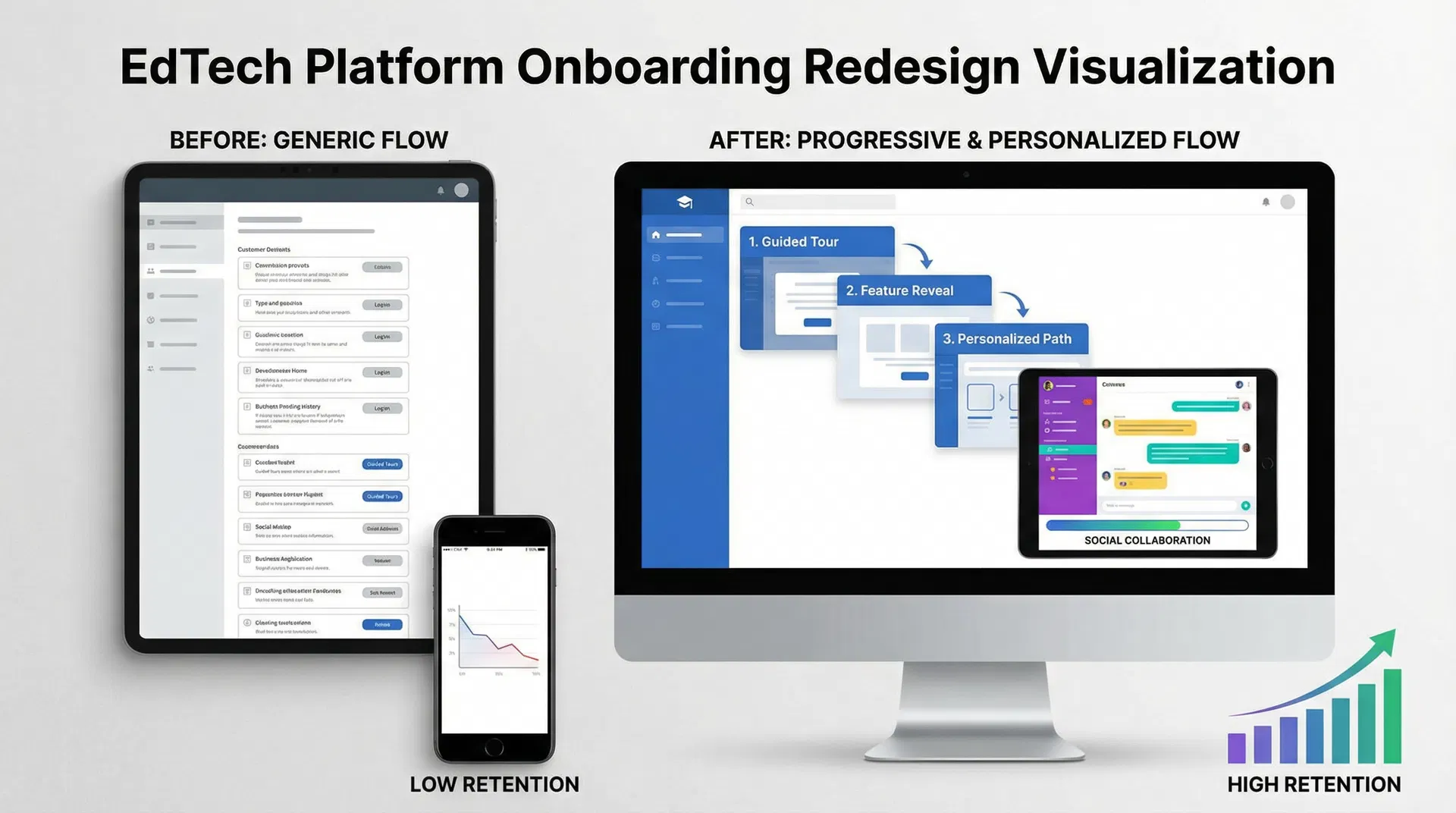
New users were abandoning the platform during setup due to overwhelming feature set and unclear learning paths. The onboarding process took 45 minutes on average, and only 28% of users completed a full course within 30 days.
Solution
Implemented progressive disclosure onboarding with guided tours tailored to user goals, created personalized learning path recommendations, added offline content access for mobile learners, and redesigned social learning interface with peer collaboration features. Reduced onboarding time from 45 minutes to 15 minutes through streamlined setup process.
Research Phase
Optimizing EdTech Platform User Onboarding for Time-to-First-Value and Retention
Duration: 3 months | Participants: 750
Research Methods
Key Findings
Initial Engagement
Users often drop off during the initial sign-up process due to lengthy forms and unclear value proposition.
Impact: Simplified sign-up flow, introduced progress indicators, and highlighted immediate benefits of platform features.
Feature Discovery
New users struggle to discover key features relevant to their learning goals, leading to underutilization.
Impact: Implemented personalized onboarding tours based on declared interests and integrated contextual help tips.
Motivation & Retention
Lack of early success or perceived progress demotivates users, impacting long-term retention.
Impact: Introduced micro-achievements for early wins, personalized learning paths, and automated progress reports.
User Personas
Understanding the diverse needs and motivations of key user segments
Amelia Chen
University Student
Higher Education Institution
BACKGROUND
Amelia is a 20-year-old university student pursuing a degree in Computer Science. She is tech-savvy and uses various online tools for her studies. She is looking for an EdTech platform that can help her supplement her coursework, prepare for exams, and collaborate with peers.
GOALS
- •Improve understanding of complex topics
- •Prepare effectively for exams and assignments
- •Collaborate with classmates on projects
PAIN POINTS
- •Overwhelmed by too much information during onboarding
- •Difficulty finding relevant courses or study materials quickly
- •Lack of clear guidance on how to maximize platform features
"I need a platform that gets straight to the point and helps me learn what I need without a lot of fuss."
David Miller
High School Teacher
Secondary School
BACKGROUND
David is a 45-year-old high school history teacher. He is moderately comfortable with technology but prefers straightforward and intuitive interfaces. He wants to use an EdTech platform to find supplementary resources for his lessons, assign homework, and track student progress.
GOALS
- •Find engaging and accurate supplementary teaching materials
- •Efficiently assign and grade homework
- •Monitor student performance and identify areas for improvement
PAIN POINTS
- •Time-consuming initial setup and course creation
- •Difficulty integrating the platform with existing teaching workflows
- •Lack of clear tutorials for advanced features
"I'm open to new tools, but they need to be easy to pick up and use in my busy schedule."
Sarah Lee
Lifelong Learner
Self-employed
BACKGROUND
Sarah is a 32-year-old self-employed graphic designer who is constantly seeking to acquire new skills to stay competitive in her field. She is comfortable with technology and is looking for an EdTech platform that offers flexible, self-paced courses in various creative and technical subjects.
GOALS
- •Acquire new skills relevant to her career
- •Access high-quality, up-to-date course content
- •Learn at her own pace and on her own schedule
PAIN POINTS
- •Unclear navigation to relevant skill paths or courses
- •Difficulty understanding the value proposition of premium features during trial
- •Lack of personalized recommendations for skill development
"I need a platform that understands my learning journey and helps me discover the next step in my skill development."
Implementation Approach
Research & Strategy
3 weeks
- Session recording analysis
- User interviews
- Churn analysis
- Persona development
Design & Testing
5 weeks
- Onboarding flow redesign
- Prototype development
- A/B testing with users
- Iteration based on feedback
Implementation & Optimization
4 weeks
- Development and deployment
- Analytics setup
- Performance monitoring
- Continuous optimization
Outcomes & Results
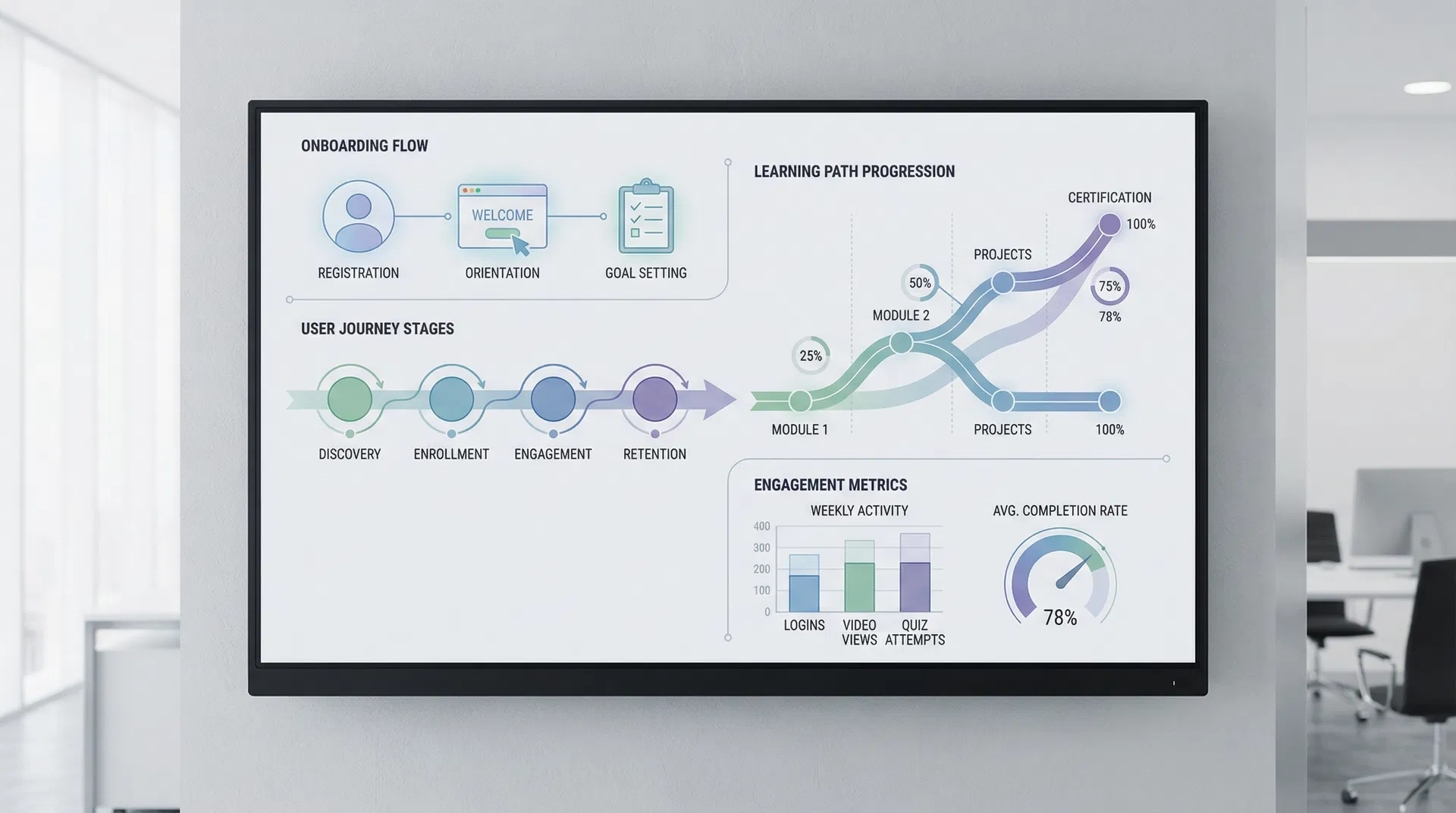
Dramatically improved enterprise user onboarding through research-driven design, reducing time-to-value and increasing feature adoption and retention.
-70%
Time-to-First-Value
From 40+ min to 5-10 min
+35%
Feature Adoption (30 days)
Increase in feature usage
+55%
Onboarding Completion
Completion rate improvement
-40%
Churn Reduction
During onboarding period
+28 points
NPS Score
Improvement in onboarding NPS
Business Impact
- Improved user experience and satisfaction
- Enhanced product competitiveness
- Increased user engagement and retention
- Reduced operational costs
Research Visualizations
Key Learnings
Personalization Drives Engagement
Key Insight
Tailoring the onboarding experience to individual user needs and learning styles significantly accelerates time-to-first-value and feature discovery. Dynamic content and adaptive paths are crucial.
Iterative Design is Essential for Optimization
Key Insight
Continuous A/B testing and feedback loops are vital for refining onboarding flows. Small, data-driven iterations lead to substantial improvements in retention and user satisfaction.
Clear Value Proposition is Paramount
Key Insight
Explicitly communicating the platform's core benefits and how to achieve them early in the onboarding process is key to reducing drop-off rates and boosting retention.
Analytics are the Foundation for Success
Key Insight
Robust tracking and analysis of user behavior during onboarding provide actionable insights, enabling proactive adjustments and ensuring the experience remains effective and engaging.